Tuesday, 24 January 2012

Exercise - Image Development


For this exercise I chose to work with a piece by David Wenzel, who is known, primarily, for his illustration work on the graphic novel, 'The Hobbit'.
I have included below a small biography on him, and a couple of images from 'The Hobbit', but for more of his work please click on the link to his website.


The piece of work I chose, is called Ivans Hat, and is an image full of detail in the background, so I thought it would be good for this exercise.
I used the 'L' shaped pieces of card to produce ten images in several different formats.


The titles that I have used, I think do represent the content, one or two of them were slightly more abstract than the others, but on the whole I think anyone looking at them may be able to see, what I can see.

After much thought, I chose the image titled 'Takeaway', because I loved the quirkiness of it, the man with the large pizza shaped hat suggested something you may see on an advertisement for a fast food outlet.


I tried out several different typeface, using the word 'Takeaway', then sketched a few poster layout ideas, with the image, text etc in different places.


Then I sketched the image a couple of times so that I could try out methods of colouring, producing one with acrylics and one with watercolour and pen, because the original image was done with watercolour washes I thought that it might be good to do the same.

I decided to go with a variation on the first and second poster ideas I had sketched roughly, with the image at the top, text underneath, which was the Book Antiqua typeface, and a border of pizza topping ingredients around it.
I did not want a printed text, so I copied the text to the best of my ability, and painted it in red, which with the green border, are the two most important colours used normally to promote a traditional pizzeria, because they are part of the Italian Flag.


The pizza slice underneath is an extra I wanted to add, so that there was not a large gap on the poster.

In conclusion I am quite pleased with the end image, as I think I worked my way through this exercise well, trying to match the style and content of the original image, rather than changing it too much, so that it lost its original identity.
I think I extended the meaning in the poster, so that the man went from just wearing a large pizza shaped hat, to being someone who promotes food.

Wednesday, 11 January 2012

Exercise - Reading an Image - Hierarchy in the Image


What is the image about?  What is it saying?

Dominating the image is a large, red dragon, lying curled up asleep, on top of some treasure, in a cave.

In front of him are swords, shields and armour etc, possibly from soldiers/knights that the dragon has defeated in battle, probably over the treasure that he is now protecting.

Also in the cave, are two people.
They both look young in age because of their appearance, they are not dressed in armour, so are not great knights or warriors, they look more like explorers, one is carrying a torch, which is lighting up the darkness of the cave.
The person at the front, looks like a young girl, her body language is bold, and there is another person, behind her, cowering and gesturing for them both to leave.

Work out the narrative and identify the story.

This is a childrens fantasy story, and I think it is about adventure, treasure seeking, a battle between good and evil, and possibly about weak overcoming the strong, a David and Goliath type tale, i.e. no matter what size you are you can still be strong.

It reminds me of Tolkiens ‘The Hobbit’ where dwarves and a hobbit defeat the great dragon, Smaug to get the treasure, using not strength and size, but cunning to reach their goal.

The chair that the dragon is curled around looks like it could be a throne, so it could be that the dragon has taken over a kingdom, defeating its king or queen and their army.

Describe the palette and tonal range which has been used.  Note if the colours are hot or cold, whether the elements are detailed or textured, and where these approaches are used.

Hotter Colours:

Firstly, the most dominant colour is red, which being a very bright, rich colour, it immediately catches your eye.  This has been used to describe the colour of the dragon, the torch reflection on the wall of the cave and the torch itself.  On the outside of the dragon facing away from the two people with the torch, there is a darker red that has been used, to create shadow, this then progresses gradually to a lighter, brighter red, helping highlight the areas lit up by the torch.
This progression in colour from dark to light gives us, as the reader, an idea as to how far the light from the torch spreads.

The next colour is orange/yellow which has been used to colour the treasure and the rest of the reflection on the wall.  The treasure colour is important, gold has greater worth than any other precious metal, it is also easily identifiable, so painting the treasure this colour makes you realize it is not just a pile of stones that the dragon is lying on top of and protecting.

Cooler Colours:

To show this is a cave, or at least somewhere a dragon might want to live or hang out, the cooler colours have an element of blue in them, to give this environment a dark, damp feel.
Where the shadows are at their darkest, behind the dragon, it is almost a deep purple, this then gets lighter the closer you get to the torchlight.  Yes the purple does have red in it, but blue is the predominant colour, so makes it a cooler colour.

The use of pale blue on the floor, shows that there is some light being reflected on to it, but not enough to use a warmer colour, as there still needs to be shown as cool/cold and damp.

There are other colours in this image, that have been used as contrast, such as the green of the chair/throne, which can be a sign of wealth/money, it is also stated that green is a neutral colour, so it is a good one to use as there is a large amount of hot and cold colours in this image.


The red colour on the walls looks almost like it is dripping down the wall, giving the idea that the wall is not smooth, but textured as is the use of a textured blue colour on the floor, to give it an uneven look.

Is there any connection between hot colour and the importance of the element in telling the story?
An important element in this story, is obviously the dragon, he/ she must be shown as fierce, perhaps fire breathing, but this is difficult when he/she is asleep. You  have to remember that this is a children’s story, so you cannot bring too many frightening details, visually, into it.  As most children are aware, and would be if they were reading this story on their own,(which I think is probably aimed at seven to eight year olds) red is normally associated with fire, heat, flames etc, so use of this colour is vital, to portray this, as the first thing you would look at in the illustration is the dragon, followed by the other elements, in order of whether the colours are hot or cold.

Exercise - Illustrating Visual Space


Picture 1 - The child dominates this image, the building is in the distance on the horizon line, and the child appears to be walking towards both the tree and the building, but there is no object directly in the middle ground space. The tree at an angle might suggest uneven ground.


Picture 2 - I did not use images all the same size in this illustration, so I could produce an illustration that had dominating objects.
In this image the child is small, the horizon level, but the building is quite large resting on it, the tree is large and ominous in the foreground.  This image works reasonably well, although the child further towards the building could have created more of a working illustration.

Picture 3 - In this image the building is the dominant feature, creating a dark, sinister element.  The tree is a small, stark outline on the horizon, suggesting distance between the objects.


Picture 4 - This image has the child again as the dominant feature, the child in the corner of the frame is looking towards the middle and far distance objects, it does create visual space, but the scale of the objects is just right, for the position they are in.


These are the original images I chose, before I photocopied them.


Picture 5 - Using a different shaped horizon, these images are all of a similar scale, so it does not create visual space, but it is a quirky composition.


Picture 6 - Using the diagonal format again, the child appears to be walking towards the middle distance building, the tree is placed just below the wavy horizon line, so that it only seems just beyond the building.
There is some visual space created, but with having the objects below the horizon line, it appears as though there isn't as much.  Using the diagonal approach your eye is led into the image.


Picture 7 - Slanting horizon line, with the child walking along it, and the other two objects below it.  The building dominates this scene as it is in the foreground despite the objects being the same scale.
This image makes it appear that the child is looking down on the building, although I am not sure it creates visual space, just a  quirkiness.
The child should have probably been smaller in scale if this format were to work so that it appears to be in the distance.


Picture 8 - Another angled image with the child as the dominant figure, this time the horizon is angled in a v-shape.
The scale of the images are not right, the building should have been smaller, the tree slightly larger than it is and the child larger for it to work.  A good experiment, but not successful.


How does your sense of the image and its meaning change when the figure is smaller than the other elements?

It suggests that the child is small and fragile, that the other elements are dominating, possibly even scary.

If the elements are at different angles to each other and at an angle to the frame, what dynamic is suggested?

It can make the image seem chaotic and disorganized, perhaps floating in the visual space, but it could also draw your eye downwards as if spiraling into a hole.

If all the elements are completely horizontal and vertical in relation to the frame what dynamic is suggested?

The dynamics of this type of image/illustration suggest a calm and ordered feeling, everything in this type of illustration may be relied upon and sturdy.

Which is your favourite composition?  Explain why you feel it is the most successful.

After experimenting a great deal, I ended up with two favourites:

Picture 4 – Because it creates enough visual space, it has a foreground object, a middle distance object and something in the far distance.  It has a strong sense of calm about it, something ordered, not chaotic, but also leads your eye into it.

Picture 6 – Also creates visual space, but has a pleasing quality with the wavy horizon.  The child again leads the eye into the illustration, as if on a small trip or journey.

Thursday, 8 December 2011

Assignment 2 - Point of Sale


The brief for this assignment was to create images that could be used in a campaign for a supermarket to package and promote a range of seasonal foods.

I started off with two mood boards, one for 'autumn' and one for 'summer', gathering images from the internet, to spark off some ideas.


I tried out some colour sketches, so that I could decide whether I was going to use fruit/vegetables or both.

After doing the colour work, I did a couple of rough sketches, trying out some ideas for the illustration layouts.  The autumn one set in a vineyard, and the summer one in a  meadow.  But as my ideas began to take shape I changed my mind on both of these.


Next came the idea of making things simpler, by just having  a still life arrangement, with lettering underneath.

This last illustration for the autumn one I decided was too busy, so I went with a different more simple layout, using a basket filled with grapes, and pears and apples in front of it.

The 'summer' illustration was going to be based around a jug and bowl set with fruit tumbling out of the jug into the bowl, with other fruit sitting around the outside.

To obtain the bright colours I used acrylic paint, building up the colour of the fruit as I went.

Summer

Autumn


After experimenting with layouts, colour and content I am very pleased with the outcome of both the Summer layout and the Autumn layout.  I have shown many people both designs, during the art club sessions that I attend, and they agree that the colours are bright, and eye-catching.

In conclusion, it is better to try out several different ways of doing a brief, using the mood boards as a way of researching, but also asking public opinion, have been important factors for me in this assignment, because at the end of the day the public are the ones that will have to be enticed by the display, and if it isn't right it will not encourage them to buy.


Wednesday, 7 December 2011

Exercise - Visual Metaphors


For this exercise, we were asked to draw objects/subjects, to illustrate one of the phrases listed.
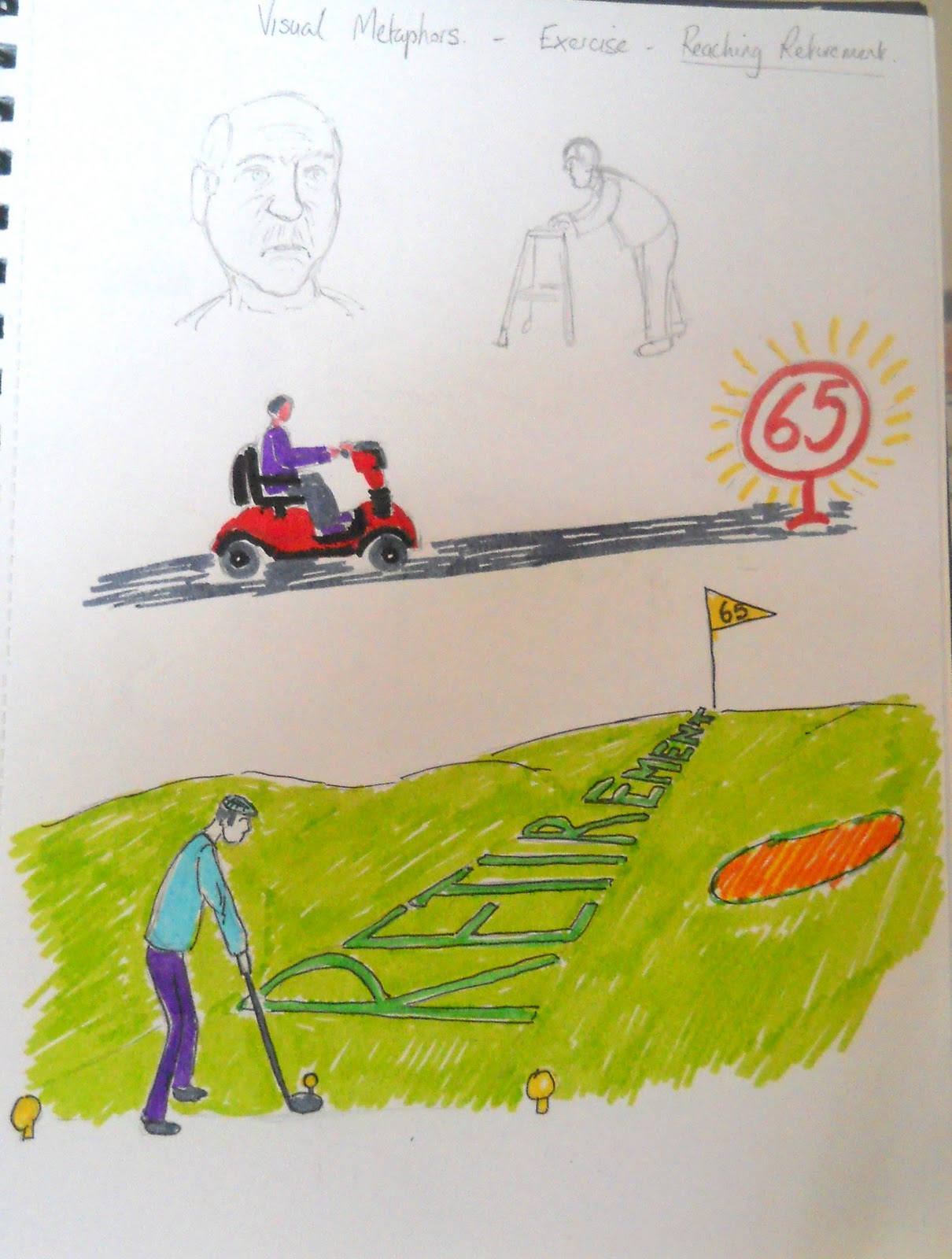
I chose the phrase 'reaching retirement', and firstly made a spider diagram to produce more words to work with.
From this I came up with some very basic sketches, not too detailed, but enough detail in them that you could further develop, I added a bit of colour just so you could see what the items were meant to be.


When I had drawn several sketches around this idea, I showed them to someone else, to see if they could identify what they were about, they had no trouble, even though the illustrations were very raw and basic.
I feel that the results were good from this exercise, but I was unused to not producing a more finished illustration.  If I was to take one of the ideas further I think the one I might have gone with would have been the last one, with the businessman running through the retirement tape, throwing his briefcase in the air as he does so.


Exercise-Choosing Content

If this were to be made into a film, what would the main character be like?

I looked on the Internet and black-and-white films of this era, the 1940s, and came across many actors-Humphrey Bogart, James Stewart and James Cagney, playing gangster/tough guy characters.

I think that these actors would have many of the qualities that the main character might have.  Tough exterior, passionate about his job, may be a bit of a tough guy, perhaps getting into scrapes through his job with new Scotland Yard.

This may be etched on his face, lines, greying hair despite his years, tired looking from many late nights on difficult cases.  Rugged looking, slightly crumpled clothes, tidy loose, and hair ruffled.

What clothes with the character be wearing?

Shirt, tie-loose end at the collar, suit trousers, with turn ups, double-breasted suit jacket which would be on the back of the chair.  A trilby style hat and long raincoat hanging on a hook on the back of the office door.

What furniture is in the main area in which the action takes place?

Because this is an office, there would be a desk, chair, (perhaps a wooden swivel one) a filing cabinet, hat/coat hook and may be a settee/couch.  Quite spartan, no frills.


I decided that because the era was probably the 1940s (because of the reference in the text), that I would go with the sort of effect that black and white films from this period had.

Many of the films were ' film noir' so the drawing I wanted to produce would have this effect too.  Lots of shadow would be needed to give it a dramatic feeling.

I created 2 mood boards showing some of the elements I wanted to include in my illustration, such as clothing, scenery, tonal values, and texture.

I used cross hatching and pen in ink, to produce the effect I needed after trying out solid black and deciding I didn't like it, because it was too heavy and I couldn't vary it enough, or give the appearance of texture.


In conclusion the piece turned out well, I managed to include some of the descriptions of the office area, a view of St Pauls, and bombed out buildings, plus some of the things I felt should be in the illustration, such as items on the desk.


The character is drawn so that he is surveying the war torn city buildings outside his office window, particularly the smoke shrouded St Pauls Cathedral, an iconic image of the war years.