Tuesday, 14 February 2012

Exercise Viewpoint


For this exercise, we were asked to choose a selection of objects to photograph, along one of the theme’s listed.

I chose the theme ‘The Morning After’, so gathered bottles of various shapes and sizes, and three or four glasses.

I set them up on a small kitchen table against a plain wall, and photographed them from different angles, zooming in and out so that I could capture different parts of the set up.

I then chose twelve images and printed them off so I could put them in my sketchbook.

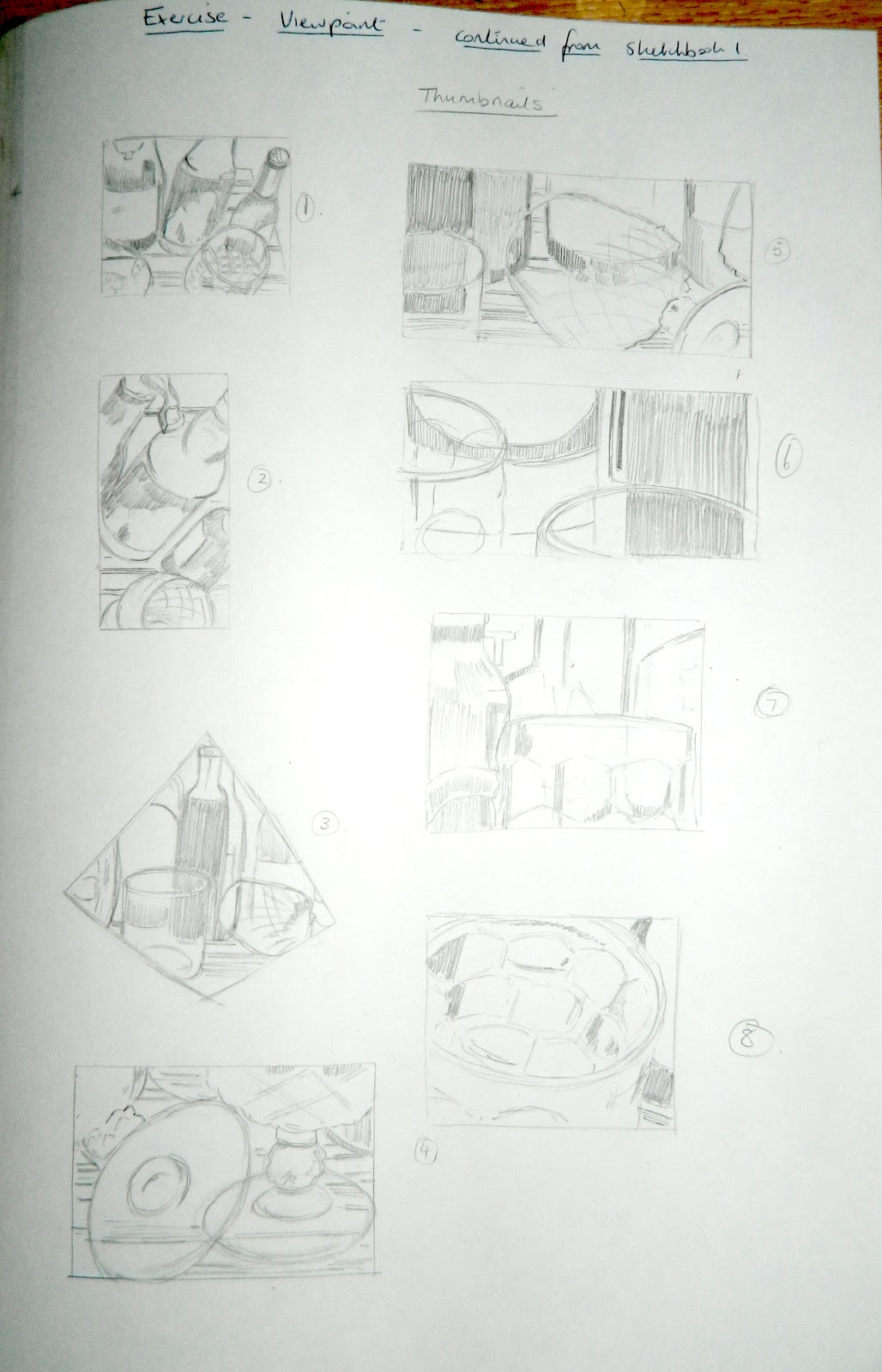
Using masking tape I created square, thin rectangle, diamond and rectangle formats on the images to use for thumbnail sketches.


From these thumbnail sketches I chose Image Number 2 as my favourite, to make into a larger illustration.
I liked the way the bottles appear at angle, giving the overall design an interesting feel to it.


Which viewpoint best fitted the word your objects illustrated?  Why was this?

The viewpoint I think best suits the words ‘The morning after’ is the one displayed in image six.  This is a nice clear view of the whisky bottle, which is half full, and an empty bottle next to it, which implies, perhaps, that it has been a heavy night of drinking. Having the image zoomed in like this doesn’t give much detail of what else could be going on, so you have to make your own conclusions from it.

Which format best illustrated your words?

I chose to go with rectangular and square shaped formats on the whole, as I felt it didn’t overpower the shapes and angles of the bottles etc on the images where I had zoomed in, or taken the shots with the camera from above, so these formats I would say best illustrated the words.

Did changing viewpoints make you think differently about your choice of objects and arrangement of them?

I don’t think that changing the viewpoints made me want to choose different objects, because I zoomed in quite tightly with the camera on some of the bottles and particularly the brandy glass, I found it made some everyday objects seem more interesting, the detail was greater, giving more meaning to the subject.


Friday, 10 February 2012

Giving Instructions


For this exercise we had a choice, of what subject we could illustrate.

I chose ‘Making a cup of Tea’, which sounds very simple, but I had to think of a way of showing the instructions to someone who perhaps has never made a cup of tea before.

First, I looked on the internet for examples of illustrated instructions, and I found quite a few, the most popular seemed to be instructions for flat-packed furniture, but I did manage to find some for tea making.


Next I looked for images of kettles, cups, teapots etc, which I needed for reference material, I found a lot of them on the internet but also in catalogues from Littlewoods and Very.

I drew some spider diagrams, so that I could decide what I would include in the process of tea making, should I include everything in it, such as the tea leaves growing, being picked etc, or just stick to the actual making of it?


Using the reference photos I had gathered, I started sketching ideas on how the illustration might look.

I came up with four ideas, The spiral, (inspired by the example piece in the course notes), Flow Chart, Tea Leaves and Tea Cup/Teapot.

Trying out the different shapes and styles gave me an idea, on whether they would work.
I needed to make sure that the images flowed correctly, they needed to draw the eye into the illustration , so that the process of making the tea was clear.


I made the decision to use a combination of ideas, so I selected the tea cup shape, but changed the view to above the cup as opposed to a side view, and the original spiral, which I liked in the beginning.

I used watercolours for this exercise, as I liked the subtle tones they produced in the practice exercises.
The colours I used were chosen because they were representational, of the green tea leaves and the warm brown tea.


I decided to leave the background of the overall image and the background of the smaller images white so as not to confuse the eye, and keep the images crisp and clear.

The tea leaves, biscuits and the spoon help give clarification to the image as a whole, otherwise the circle shapes of the cup and saucer would not have any meaning to them.


I asked my eleven year old daughter, and a couple of adult friends to look at my illustration to see if it had a clear message to it, they all agreed that it was easy to follow, they knew where to start and finish, each of the smaller images were clear and precise, and the colours used were subtle, not confusing.

In conclusion I feel that the illustration has worked well, it shows how to make a cup of tea, it is pleasing to the eye and has enough important detail in it without making it too confusing.